
Notre Dame Cathedral
Updated · BootsnAll
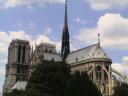 Notre Dame Cathedral in Paris is not the biggest, the tallest, or the oldest cathedral in the world, but it certainly is one of the most well known. Whether Notre Dame brings to mind Victor Hugo's hunchback, Quasimodo or past architecture classes on 'flying buttresses', seeing the cathedral in the 'flesh' should be one of your 'musts' on any trip to Paris. If you're not a churchgoer, the cathedral can be admired just as well from the exterior as from the interior.
The 2019 fire, and the reopening
On 15 April 2019 a fire destroyed Notre Dame's roof and its 19th-century spire, and the cathedral closed to the public. After a reconstruction lasting more than five years it reopened on 7 December 2024, with the spire rebuilt to Viollet-le-Duc's design and the interior stonework cleaned far beyond its pre-fire condition.
Everything below describes visiting the cathedral as it is now, but details around a reopening of this size change often. Check the official Notre Dame de Paris website before you go, particularly for the towers and for anything time-specific.
The construction of Cathedral of Notre Dame de Paris began in 1163 during the reign of Louis VII. It took 200 years (completed in 1345) to finish building this marvel of gothic architecture.
Although much of what you see today is the result of 19th century restorations by Viollet le Duc, its medieval character remains intact and keeps us in touch with the religious fervor that helped realize such an ambitious architectural feat.
Here’s some trivia: Notre Dame has witnessed the crowning of a variety of kings, queens, emperors and empresses. Henry VI, King of England was crowned here in 1430. (By the way, dare I say it, but Paris was occupied by the English longer than most Parisians care to remember. If Joan of Arc hadn't shown up, who knows?
Mary Stuart was crowned Queen of France here (she married Francis II).
Napoleon and Josephine crowned themselves emperor and empress. Originally the pope was supposed to crown Napoleon but he was so eager to become Emperor that he plunked the crown on his head before the pope had time to reconsider.
Getting there
Notre Dame Cathedral in Paris is not the biggest, the tallest, or the oldest cathedral in the world, but it certainly is one of the most well known. Whether Notre Dame brings to mind Victor Hugo's hunchback, Quasimodo or past architecture classes on 'flying buttresses', seeing the cathedral in the 'flesh' should be one of your 'musts' on any trip to Paris. If you're not a churchgoer, the cathedral can be admired just as well from the exterior as from the interior.
The 2019 fire, and the reopening
On 15 April 2019 a fire destroyed Notre Dame's roof and its 19th-century spire, and the cathedral closed to the public. After a reconstruction lasting more than five years it reopened on 7 December 2024, with the spire rebuilt to Viollet-le-Duc's design and the interior stonework cleaned far beyond its pre-fire condition.
Everything below describes visiting the cathedral as it is now, but details around a reopening of this size change often. Check the official Notre Dame de Paris website before you go, particularly for the towers and for anything time-specific.
The construction of Cathedral of Notre Dame de Paris began in 1163 during the reign of Louis VII. It took 200 years (completed in 1345) to finish building this marvel of gothic architecture.
Although much of what you see today is the result of 19th century restorations by Viollet le Duc, its medieval character remains intact and keeps us in touch with the religious fervor that helped realize such an ambitious architectural feat.
Here’s some trivia: Notre Dame has witnessed the crowning of a variety of kings, queens, emperors and empresses. Henry VI, King of England was crowned here in 1430. (By the way, dare I say it, but Paris was occupied by the English longer than most Parisians care to remember. If Joan of Arc hadn't shown up, who knows?
Mary Stuart was crowned Queen of France here (she married Francis II).
Napoleon and Josephine crowned themselves emperor and empress. Originally the pope was supposed to crown Napoleon but he was so eager to become Emperor that he plunked the crown on his head before the pope had time to reconsider.
Getting there
 Notre Dame Cathedral is located on the Ile de la Cite in the middle of the Seine River. If you're staying on the Right Bank or the Left Bank, you'll have to cross a bridge to get to Notre Dame. The Metro stop, Cite, or the RER stop, St. Michel will bring you within five minutes from the cathedral's front door.
Hours and entry
Entry to the cathedral is free, as it has always been. Since the reopening the crowds have been heavy enough that a free timed reservation is the practical way in rather than queueing, and opening hours have been adjusted more than once. Both are published on the official website, which is the only source worth trusting on the day.
The towers are managed separately from the cathedral, by the Centre des monuments nationaux, and are ticketed. There are 387 steps and no lift, so you need to be in reasonable shape. Tower access, its price and its booking arrangements have all changed since the fire; book through the Centre des monuments nationaux rather than relying on a figure quoted anywhere else.
Notre Dame is an active place of worship as well as a monument. Mass and other services are held daily, attendance is free, and concerts are held in the cathedral through the year.
Another way to appreciate the interior of this labor of love is by attending one of the many concerts. Although Notre Dame is an active place of worship, it's also a gift of medieval artisans to all the generations that have followed them - and all the visitors of various beliefs who come to admire a labor done not for financial rewards but for spiritual rewards.
Would you like to read more about Notre Dame Cathedral?
Churches: Great architecture or symbols of Exploitation?
Notre Dame in Wikipedia
Notre Dame Cathedral is located on the Ile de la Cite in the middle of the Seine River. If you're staying on the Right Bank or the Left Bank, you'll have to cross a bridge to get to Notre Dame. The Metro stop, Cite, or the RER stop, St. Michel will bring you within five minutes from the cathedral's front door.
Hours and entry
Entry to the cathedral is free, as it has always been. Since the reopening the crowds have been heavy enough that a free timed reservation is the practical way in rather than queueing, and opening hours have been adjusted more than once. Both are published on the official website, which is the only source worth trusting on the day.
The towers are managed separately from the cathedral, by the Centre des monuments nationaux, and are ticketed. There are 387 steps and no lift, so you need to be in reasonable shape. Tower access, its price and its booking arrangements have all changed since the fire; book through the Centre des monuments nationaux rather than relying on a figure quoted anywhere else.
Notre Dame is an active place of worship as well as a monument. Mass and other services are held daily, attendance is free, and concerts are held in the cathedral through the year.
Another way to appreciate the interior of this labor of love is by attending one of the many concerts. Although Notre Dame is an active place of worship, it's also a gift of medieval artisans to all the generations that have followed them - and all the visitors of various beliefs who come to admire a labor done not for financial rewards but for spiritual rewards.
Would you like to read more about Notre Dame Cathedral?
Churches: Great architecture or symbols of Exploitation?
Notre Dame in Wikipedia