


Guide to RER Trains in Paris
· BootsnAll
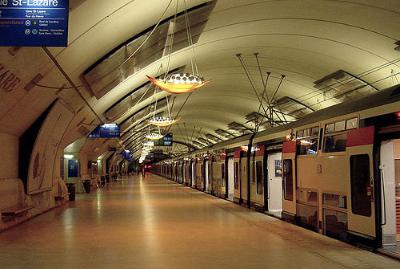 Anyone who's heading for Paris with an ounce of preparation (or, at the very least, a good guidebook for in-flight reading) will know that this city has one of the best underground transportation systems anywhere. The Paris Metro, the subway system, snakes its way all over the central part of the city and well beyond, making getting from your hotel in Paris to the Eiffel Tower a simple task. But the city didn't stop with the Metro when it comes to great public transport - there's also the efficient RER train system in Paris.
Not familiar with the RER train network? I don't blame you. The Metro makes it so easy to get around the city that there's basically no incentive to figure out things like the bus lines in Paris. But the RER is so easy to use, and so well-integrated with the Metro, that it's not a bad idea to get acquainted with it so that you can make getting around the City of Lights even quicker and easier.
Tourists in Paris may think they have no cause to figure out the RER lines so long as they're sticking to the main tourist sights. But here are a few reasons you'll want to pay attention to the RER lines, too - there's an RER into Paris from Charles de Gaulle Airport or Orly Airport, and you can take the RER from Paris to Versailles or Disneyland Paris. See? The RER can definitely be a tourist's friend in Paris.
Anyone who's heading for Paris with an ounce of preparation (or, at the very least, a good guidebook for in-flight reading) will know that this city has one of the best underground transportation systems anywhere. The Paris Metro, the subway system, snakes its way all over the central part of the city and well beyond, making getting from your hotel in Paris to the Eiffel Tower a simple task. But the city didn't stop with the Metro when it comes to great public transport - there's also the efficient RER train system in Paris.
Not familiar with the RER train network? I don't blame you. The Metro makes it so easy to get around the city that there's basically no incentive to figure out things like the bus lines in Paris. But the RER is so easy to use, and so well-integrated with the Metro, that it's not a bad idea to get acquainted with it so that you can make getting around the City of Lights even quicker and easier.
Tourists in Paris may think they have no cause to figure out the RER lines so long as they're sticking to the main tourist sights. But here are a few reasons you'll want to pay attention to the RER lines, too - there's an RER into Paris from Charles de Gaulle Airport or Orly Airport, and you can take the RER from Paris to Versailles or Disneyland Paris. See? The RER can definitely be a tourist's friend in Paris.
About the RER
RER stands for "Réseau Express Régional," which translates to "Regional Express Network." Whereas the Metro has 16 lines, the RER has only five. The Metro's lines are numbered, and the RER lines are represented by letters - so it's easy to know immediately which kind of transit system you're heading for. Because the RER serves both the Paris city center and its suburbs and is therefore popular as a commuter rail network, there are lots of places where it intersects with the Metro network as well as the SNCF rail stations in Paris for easy transfers. The five lines of the RER are, as mentioned, designated by letters - they are lines A, B, C, D, and E. Lines A and B are the busiest, as they connect the Paris city center with EuroDisney, CDG Airport, and Orly Airport, but there are more than thirty RER stops in Paris. On this map of the central RER network, you can see each of the five lines running through well-known parts of Paris: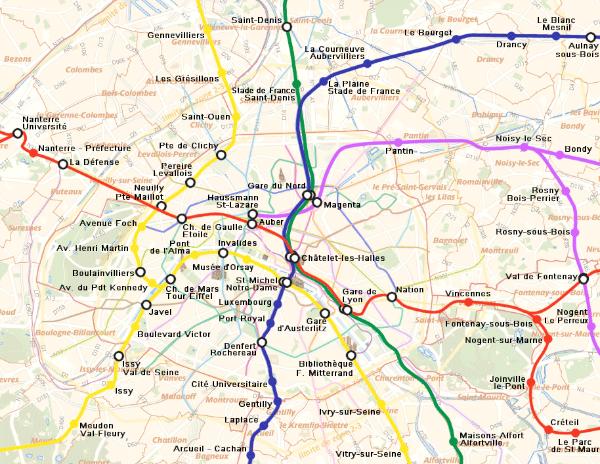 On this map of the Paris region, you can see how the RER lines extend well beyond the central part of the city:
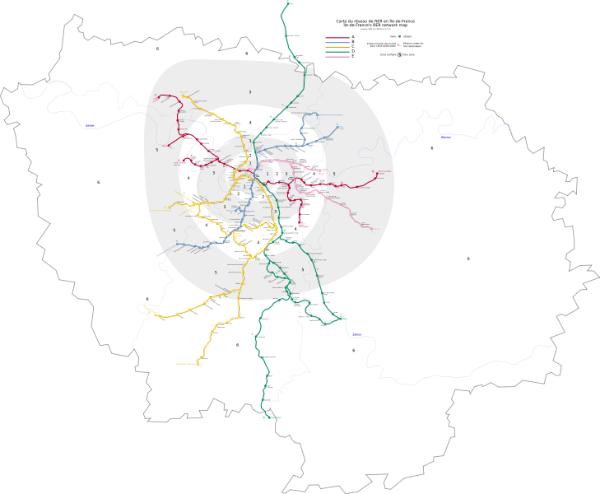 >> For an RER map you can actually use without a magnifying glass, see the official RATP website which has a great map here.
RER Stations
 Because of these intersections, there are some stations in Paris through which you can board Metro, RER, or SNCF trains - and some which are dedicated to one type of train or another. You'll be able to tell the which ones are RER stations because of the big blue signs with "RER" in white letters in the center. Underneath the big "RER" sign there's a smaller one that tells you specifically which of the five RER lines stops at that station.
The main RER stations in Paris which you are likely to make use of during your visit include Charles de Gaulle-Etoile, La Defense, Chatelet-Les Halles, and Gare de Lyon (RER A); Gare du Nord (RER B, C, & D); and Haussman-Saint-Lazare (RER E).
Because of these intersections, there are some stations in Paris through which you can board Metro, RER, or SNCF trains - and some which are dedicated to one type of train or another. You'll be able to tell the which ones are RER stations because of the big blue signs with "RER" in white letters in the center. Underneath the big "RER" sign there's a smaller one that tells you specifically which of the five RER lines stops at that station.
The main RER stations in Paris which you are likely to make use of during your visit include Charles de Gaulle-Etoile, La Defense, Chatelet-Les Halles, and Gare de Lyon (RER A); Gare du Nord (RER B, C, & D); and Haussman-Saint-Lazare (RER E).


